
QNAP TL-D1600S
4.5Editor score
16 SATA Drive Bays
PCIe SATA Interface Included
Desktop JBOD Storage
This guide compares the top 16 bay NAS enclosures for enterprise and home use, evaluating performance, scalability, and reliability features.
Selecting the right 16 bay NAS enclosure is crucial for businesses and power users needing massive storage scalability. These units support numerous drives to ensure data redundancy and high throughput for demanding workloads.
We evaluated ten leading models based on processor power, network connectivity, expansion capabilities, and build quality. Our analysis covers both rackmount and desktop options from top manufacturers like Synology and QNAP.
Each pick highlights specific strengths to help you match hardware to your needs. Prices and availability change frequently so verify current listings before purchasing to ensure you get the best value today.
4.5Editor score
4.3Editor score

4.2Editor score
This side by side comparison highlights the key specifications of every model reviewed. Use this table to quickly assess drive bays, interface types, and expansion options.


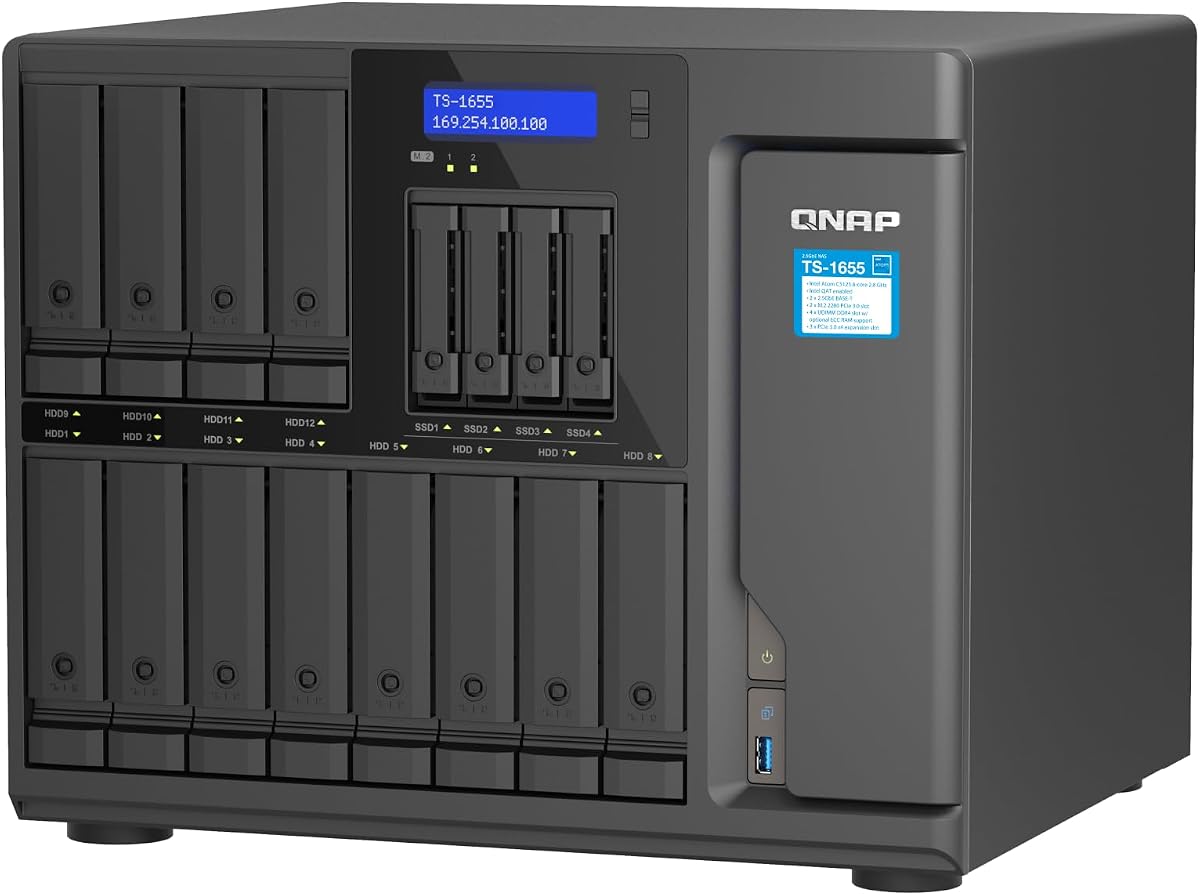
The QNAP TS-1655 stands out as a top contender for those needing a robust hybrid NAS. It combines traditional spinning drives with fast SSDs for caching to deliver exceptional performance.
We may earn a commission when you buy through this link, at no additional cost to you.
Its Intel Atom processor handles virtualization and media tasks with ease. The dual 2.5GbE ports ensure your network is not a bottleneck during large file transfers.
While it is more expensive than basic enclosures the flexibility it offers justifies the cost. Users can expand RAM significantly which aids in running complex applications simultaneously.
This unit is ideal for small businesses or enthusiasts who need speed and capacity. It balances power and efficiency better than most competitors in this category.
Mixing HDDs and SSDs allows for large capacity without sacrificing access speed for frequently used files.
Dual 2.5GbE ports provide a significant upgrade over standard gigabit connections for busy environments.
We may earn a commission when you buy through this link, at no additional cost to you.
This Synology RackStation is designed for enterprise environments where reliability is non-negotiable. It supports up to forty bays with expansion units making it future proof for growth.
We may earn a commission when you buy through this link, at no additional cost to you.
The processor handles compute intensive services efficiently while maintaining stable storage operations. Redundant power supplies ensure your data remains accessible even during hardware failures.
The investment is substantial but justified for mission critical infrastructure. It integrates seamlessly with Synology software which simplifies management significantly.
Organizations needing maximum uptime and expansion should consider this model. It represents the pinnacle of rack mounted NAS hardware available today.
Built-in redundancy features keep your systems running smoothly even when individual components fail unexpectedly.
Adding expansion units allows you to grow storage capacity without replacing the entire system or data.
We may earn a commission when you buy through this link, at no additional cost to you.
The TL-D1600S offers an easy way to add massive storage to an existing PC or server. It acts as a direct attached storage unit which simplifies the architecture.
We may earn a commission when you buy through this link, at no additional cost to you.
It supports both 3.5 and 2.5 inch drives giving you flexibility in drive selection. The included PCIe card ensures connectivity on systems lacking native ports.
While it lacks the brain of a full NAS it is perfect for raw storage expansion. It is a cost effective solution for backup or archival needs.
Home labs or small businesses on a tight budget will appreciate this value. It provides the drive capacity you need without unnecessary overhead features.
Connecting via PCIe offers a straightforward path to expand storage without managing network configurations.
Support for mixed drive sizes allows you to use existing inventory efficiently to maximize total capacity.
We may earn a commission when you buy through this link, at no additional cost to you.
This rackmount unit is designed for spaces where depth is a constraint. It fits easily into smaller cabinets while still offering sixteen drive bays for significant capacity.
We may earn a commission when you buy through this link, at no additional cost to you.
Redundant power supplies are standard ensuring continuous operation in professional settings. The Mini SAS HD connection offers reliable high-speed data transfer to the host.
While it is a JBOD unit it brings enterprise features to a desktop environment. It is well built and designed to withstand long periods of operation.
Data centers or offices with limited rack space should look at this model. It balances footprint and capacity effectively for demanding storage environments.
The short depth design makes installation in cramped server rooms much easier than standard models.
Redundant power supplies provide a safety net against electrical issues to prevent downtime.
We may earn a commission when you buy through this link, at no additional cost to you.
This enclosure provides a simple way to access multiple drives via USB. It is perfect for users who need to read from or write to many disks without a complex setup.
We may earn a commission when you buy through this link, at no additional cost to you.
The aluminum casing helps dissipate heat from the drives during heavy use. Hot swappable capabilities allow you to change drives without powering down the unit.
Be aware that USB 3.0 speed may limit large transfer tasks compared to internal SATA. The fans can be noisy so placement matters in quiet environments.
For home use or occasional data recovery this unit is highly practical. It offers significant capacity in a portable form factor at a low cost.
The external USB interface makes it easy to move large storage arrays between different machines easily.
Hot swappable slots let you remove drives safely without risking data corruption during operation.
We may earn a commission when you buy through this link, at no additional cost to you.
This full tower case is designed for serious builders wanting a dedicated server environment. It supports a wide range of motherboards and offers massive expansion potential.
We may earn a commission when you buy through this link, at no additional cost to you.
Fifteen hot swappable drive bays allow you to build a massive storage system easily. The build quality is robust ensuring physical security for your hardware components.
Shipping takes time due to sea freight so plan ahead for your project. It is heavier than standard cases so ensure you have a strong table.
For DIY enthusiasts this is one of the best chassis options available. It gives you the freedom to build a custom NAS without pre installed software.
With multiple PCIe slots you can add custom controllers for even more advanced storage capabilities.
The large internal volume and support for extra fans keep temperatures low under heavy loads.
We may earn a commission when you buy through this link, at no additional cost to you.
This Synology DiskStation provides a solid foundation for a professional storage environment. The Xeon processor ensures smooth operation even with multiple concurrent connections.
We may earn a commission when you buy through this link, at no additional cost to you.
You can expand to thirty six bays with expansion units which offers significant room to grow. The DSM interface makes management accessible even to non-technical users.
While the base unit has fewer drives the expansion options make up for it easily. It is a reliable choice for businesses needing centralized backup and file services.
Organizations prioritizing ease of use and software support will find this model ideal. It delivers a stable platform for long term data management needs.
Synology DSM provides a polished interface that simplifies complex storage tasks into easy clicks.
Built in security tools help protect your data from ransomware and unauthorized access attempts.
We may earn a commission when you buy through this link, at no additional cost to you.
This unit is purely for expanding existing Synology storage systems without adding complexity. It connects seamlessly to the base system to add twelve drive slots.
We may earn a commission when you buy through this link, at no additional cost to you.
The E-SATA link ensures high speed data transfer between the host and the drives. It is a cost effective way to grow storage capacity over time.
Since it has no brain of its own it relies on the main NAS for logic. This simplifies the ecosystem and reduces points of failure.
Users who already own a Synology device will find this the most logical next step. It ensures compatibility and preserves the user experience you expect.
Connecting to the main unit allows automatic detection and configuration without manual setup steps.
The five year warranty provides long term peace of mind for your storage investment.
We may earn a commission when you buy through this link, at no additional cost to you.
This model is optimized for creative professionals needing fast throughput for video editing. The USB4 ports allow for direct high speed external access when needed.
We may earn a commission when you buy through this link, at no additional cost to you.
ECC memory ensures data integrity which is critical for media work where corruption is unacceptable. The Ryzen CPU handles heavy media transcoding tasks smoothly.
While it has fewer bays the speed makes it valuable for high end workflows. It is a strong alternative to the usual major brands in this space.
Video editors or graphic designers working in teams will benefit from the speed. It offers a balance of performance and capacity for creative storage.
High bandwidth connections mean you can edit directly off the NAS without needing local copies.
Error correcting memory protects against silent data corruption during intensive processing tasks.
We may earn a commission when you buy through this link, at no additional cost to you.
This variant of the TS-1655 is highlighted for its performance to price ratio. It offers a massive sixteen bay layout in a single chassis.
We may earn a commission when you buy through this link, at no additional cost to you.
The Atom processor provides enough power for virtualization and heavy file serving. Long term availability ensures you will get firmware updates for years.
It might take some time to learn all features but the flexibility is worth it. It is a powerful tool for anyone needing serious local storage.
Buyers looking for maximum drive count without breaking the bank will love this. It remains one of the strongest value propositions in the market.
Commitment to long term availability means your hardware will stay relevant and updated for years.
High specs at this price point offer excellent value for performance conscious users.
We may earn a commission when you buy through this link, at no additional cost to you.
Selecting the right NAS enclosure involves balancing capacity with performance. Below are critical factors to evaluate before making your decision.
Ensure the unit supports sixteen drives as required by your needs. Consider total capacity per drive to achieve your target storage volume.
Look for models that offer hot swap slots to simplify drive maintenance.
The CPU determines how well the NAS handles virtualization and media tasks. Higher core counts help when running multiple services at once.
Select a processor that aligns with your workload intensity.
Check for 2.5GbE or 10GbE ports to avoid bandwidth bottlenecks. Faster networks allow multiple users to access files simultaneously.
Verify if the unit supports link aggregation for higher throughput.
Look for PCIe slots or expansion units if you anticipate growing storage needs. This future proofs your investment against increasing data volumes.
Expansion units add cost but provide essential flexibility for enterprise use.
Decide between a rackmount or desktop unit based on your space constraints. Rackmount saves space in offices while desktop suits home environments.
Measure your rack depth to ensure the unit fits physically.
Redundant power supplies keep your data safe during electrical failures. This is critical for business continuity in professional settings.
Check if the model comes with dual power units included.
Evaluate the NAS operating system for ease of use and security. Tools for backup and remote access are essential for modern needs.
Choose an OS that offers the applications you require daily.
A longer warranty period indicates manufacturer confidence in hardware quality. Check support resources like forums and official channels for assistance.
Prioritize brands with a history of reliable customer service.
Begin by installing your drives carefully into the bays ensuring they click securely. Connect the unit to your network and power source using the provided cables.
Access the management interface via a web browser to configure storage pools. Set up your user accounts and shared folders for easy file access.
Monitor drive health regularly using the built in tools to detect failures early. Keep firmware updated to ensure security and performance stability.
A NAS connects via a network allowing multiple users to access files simultaneously. A DAS connects directly to a single computer like a large external hard drive.
Most modern NAS systems support mixed sizes but you should verify specific model limits. Matching drive capacities helps optimize RAID performance and data recovery.
Most units listed are sold diskless meaning drives are not included. You must purchase hard drives separately to start storing data immediately.
Many models support hot swapping allowing you to change drives without powering down. Check specific product specs before to ensure this feature is available.
Most reputable brands offer a five year warranty for enterprise and prosumer units. Consumer models might have shorter coverage so check documentation carefully.
High end models with strong CPUs and sufficient RAM support running virtual machines. This is useful for hosting multiple server applications on one system.
The top picks highlighted here offer strong options for different needs and budgets. Synology and QNAP dominate the market with reliable features and performance.
Prioritize connectivity and expandability if you plan to scale your storage later. Power redundancy is essential for businesses where downtime is not an option.
Remember to check current listings before purchasing as details may vary. Investing in a quality enclosure ensures your data remains safe and accessible for years.