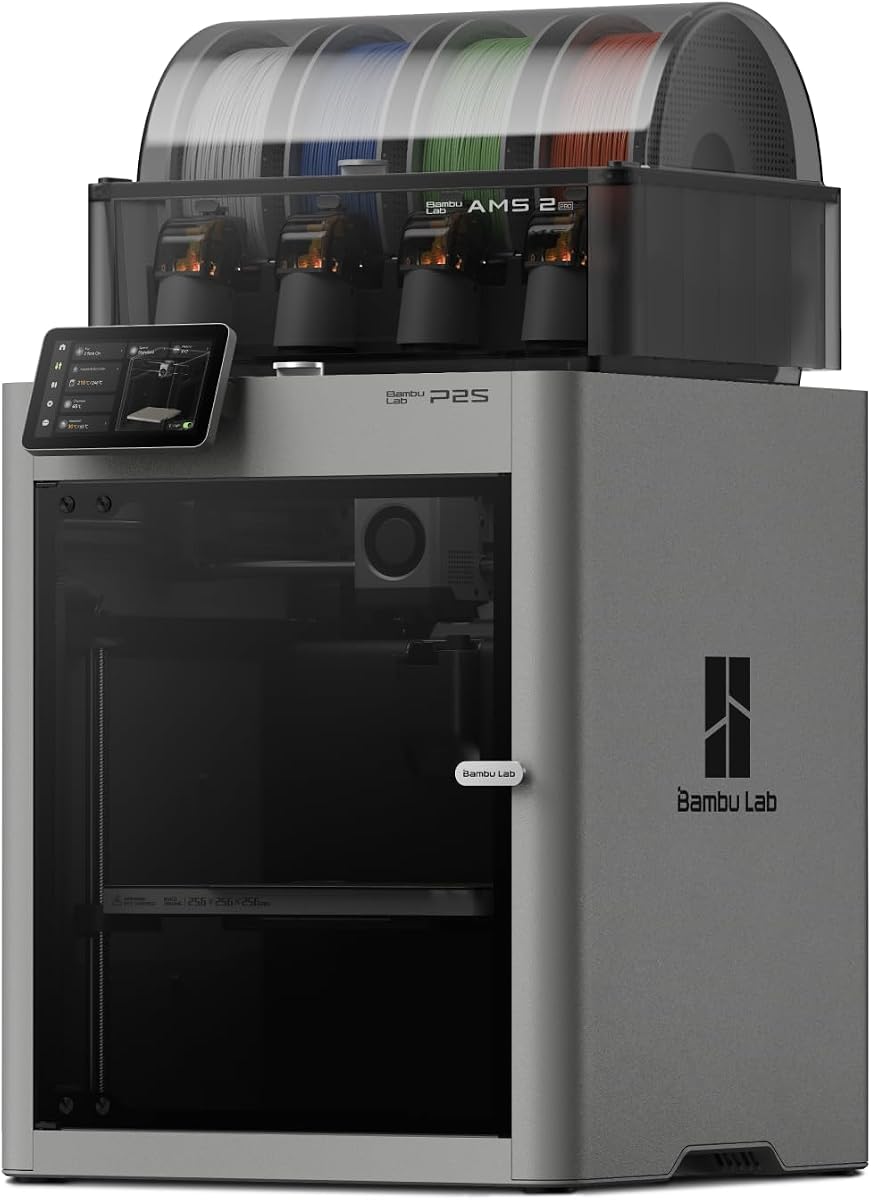
Bambu Lab P2S Combo, P2S 3D Printer & AMS 2 Pro, Multi-Color 3D Printing
4.7Editor score
High-Speed Precision
Ready to Print in 15 Minutes
Effortless Multi-Color Printing
This guide compares the best 3D Printer for Engineering Prototypes focusing on speed, material compatibility, build volume, and precision for professional
Selecting the right 3D Printer for Engineering Prototypes is crucial for rapid iteration and functional testing. Engineers need machines that deliver high precision, material versatility, and reliable performance to validate designs before mass production.
We evaluated leading models based on build volume, printing speed, material support, and ease of use. Our analysis focuses on systems that excel in professional environments where accuracy and repeatability define successful prototyping workflows.
Each pick highlights specific strengths like multi-material capability, heated chambers, or large formats. Prices and availability change frequently, so verify current details before purchasing to ensure you get the best value for your engineering budget.
4.7Editor score

3.5Editor score

4.4Editor score
This side-by-side comparison helps you evaluate key specifications across all ten top-rated engineering prototyping printers to find the perfect match for your specific design requirements and workflow needs.





The Original Prusa XL stands out as a top contender for engineering prototyping with its advanced dual-tool system and large-format capabilities. Its 3.5 rating reflects strong performance in multi-material printing and reliability for professional studios and teams requiring precise functional prototypes at scale.
We may earn a commission when you buy through this link, at no additional cost to you.
Its segmented heated bed system improves energy efficiency while ensuring reliable first-layer adhesion across the entire platform. The CoreXY motion system guarantees accurate and fast printing even during complex multi-material operations. Engineers benefit from reduced material waste and intelligent tool switching that minimizes purge waste.
While assembly can be tricky due to fragile components packed separately, the process is straightforward enough for quick setup. The price point is a consideration for smaller operations but justified by the industrial-grade output and lifetime support. Overall it delivers professional results consistently.
This printer is ideal for engineering teams and advanced makers needing reliable large-scale output. If you require seamless multi-material workflows and high precision for functional prototypes the Original Prusa XL offers the ecosystem and performance to support complex design iterations efficiently.
Seamless switching between materials enables complex prints and soluble support structures for intricate functional prototypes.
Built for engineering studios with large build volume and segmented heating for consistent performance.
We may earn a commission when you buy through this link, at no additional cost to you.
The Bambu Lab P2S Combo combines speed and multi-color capability making it a premium choice for engineering prototyping. With a 4.7 rating it excels in rapid iteration and reliable performance. The AMS 2 Pro allows seamless multi-material prints ideal for visualizing complex assemblies.
We may earn a commission when you buy through this link, at no additional cost to you.
Its PMSM Servo Extruder and Active Flowrate Compensation ensure sharp smooth layers and flawless corners. You can start printing in 15 minutes thanks to quick-swap nozzles and automatic calibration. Adaptive airflow maintains temperature control for engineering-grade materials like ABS and ASA.
While multi-color printing requires the combo version the workflow efficiency justifies the cost for many professionals. The higher price reflects advanced features like AI detection and robust hardware. It balances high-speed precision with user-friendly operation effectively.
This machine suits teams needing fast accurate prints and color variety for presentations. If you value quick setup and advanced material handling the P2S delivers consistent professional results. It reduces downtime and maximizes productivity in engineering prototyping workflows.
Up to 600 mm/s printing with servo extruder ensures accuracy and smooth layers for complex parts.
AMS 2 Pro enables effortless multi-color prints and filament drying for flawless engineering results.
We may earn a commission when you buy through this link, at no additional cost to you.
The QIDI Max4 Combo offers exceptional value for engineers needing large build volumes without breaking the bank. Rated 4.4 it supports industrial parts and complex molds in one go. Its 390×390×340mm area enables printing life-size prototypes efficiently.
We may earn a commission when you buy through this link, at no additional cost to you.
Closed-loop motors and high acceleration ensure smooth precise prints with excellent surface quality. The active heated chamber reaches 65°C for high-temperature materials like ABS-CF. AI camera monitoring detects failures instantly saving materials and time during critical prints.
Keep in mind the Polar Cooler is sold separately adding to the total cost. Multi-color requires connecting QIDI BOX which adds complexity. Still the core printing performance and material support are strong for the price point and offer great versatility.
Choose this if you need a large bed and industrial material compatibility on a budget. It suits professionals requiring high speed and stability for functional prototypes. With optional upgrades it can handle diverse engineering demands effectively.
55% larger volume than MAX3 allows single-pass printing of large industrial parts and molds.
65°C heated chamber and hardened nozzles enable reliable printing of high-performance engineering materials.
We may earn a commission when you buy through this link, at no additional cost to you.
Snapmaker U1 offers a unique four-toolhead system enabling true multi-material printing without manual swaps. Rated 4.5 it supports rigid flexible and water-soluble materials in one print. The 5-second tool changer significantly speeds up complex prototyping tasks.
We may earn a commission when you buy through this link, at no additional cost to you.
By swapping toolheads instead of purging it reduces waste by 5X lowering costs. Automatic calibration ensures smooth dimensionally accurate prints. The CoreXY system maintains stability at speeds up to 500 mm/s perfect for rapid iteration.
The smaller build volume may limit very large functional prototypes. Higher upfront cost reflects the specialized multi-head design. However the efficiency gains in complex part printing justify investment for teams needing diverse material capabilities.
Ideal for engineers creating articulated parts or multi-material prototypes in single jobs. Its smart features and speed make it a productive choice for workshops. Consider it if material flexibility outweighs sheer size requirements.
Four toolheads with 5-second change minimize waste and maximize productivity for complex prints.
Automatic offset and flow calibration deliver reliable high-quality prints with minimal manual adjustment.
We may earn a commission when you buy through this link, at no additional cost to you.
The Bambu Lab A1 brings high speed and precision to smaller spaces making it suitable for rapid prototyping. With a 4.7 rating it delivers consistent accurate prints thanks to active flow compensation. Its auto calibration simplifies setup for beginners.
We may earn a commission when you buy through this link, at no additional cost to you.
Acceleration of 10,000 mm/s² enables rapid prints without sacrificing detail. Quiet motor noise canceling allows use in offices. Multi-color capabilities unlock creativity with AMS lite though it must be purchased separately. Maintenance is easy with quick swap nozzles.
The build volume restricts larger engineering components. Additional cost for AMS lite adds to initial price. Still the speed and user-friendly interface make it a strong entry option for iterative design work.
Choose this for small part prototyping or educational environments requiring reliable performance. If space is limited but quality matters A1 delivers excellent results. Verify AMS needs before purchasing for full color capability.
10,000 mm/s² acceleration delivers blazing-fast prints while maintaining exceptional accuracy for detailed prototypes.
Full-auto calibration and quiet operation make professional-grade printing accessible to all skill levels.
We may earn a commission when you buy through this link, at no additional cost to you.
FLASHFORGE Creator 5 Pro combines industrial strength with multi-material efficiency. Rated 4.0 it features four independent toolheads and FlashSwap to eliminate purge waste. This near-zero waste system reduces operational costs significantly for high-volume prototyping.
We may earn a commission when you buy through this link, at no additional cost to you.
The fully enclosed active heated chamber up to 65°C supports advanced materials like PC and PA. CoreXY motion ensures stability at high speeds. Safety is prioritized with dual HEPA filtration capturing fumes for clean workspace conditions.
Multi-color functionality depends on accessories which adds complexity. Build size is standard not large format. The cost is higher but justified for teams prioritizing material variety and waste reduction in engineering applications.
Ideal for engineering workshops needing high throughput and material versatility. Its safety and efficiency features support professional environments well. Evaluate total accessory needs before purchasing to confirm fit for your workflow.
FlashSwap changer switches nozzles without flushing filament slashing material costs and operational overhead.
Active 65°C heating enables confident printing of ABS PC and PA for robust industrial parts.
We may earn a commission when you buy through this link, at no additional cost to you.
The Bambu Lab P1S delivers reliable performance for diverse prototyping needs. Rated 4.5 it features a fully enclosed design ideal for ABS and ASA. Setup is fast at 15 minutes reducing time to first print.
We may earn a commission when you buy through this link, at no additional cost to you.
Speed reaches 500mm/s with auto bed leveling ensuring consistent quality. Multi-color options via AMS provide creative flexibility. Carbon fiber reinforcement isn't recommended though standard engineering materials work well.
AMS must be bought separately for full color capability. Not suitable for highly abrasive fibers. Despite limitations it remains a strong versatile option for general engineering prototyping with fast setup times.
Perfect for teams needing reliable fast prints without complex calibration. Its enclosed design supports diverse materials. Consider AMS needs upfront to maximize creative possibilities.
500mm/s speeds and auto bed leveling let you focus on creating instead of waiting.
Hassle-free assembly and enclosed design ensure successful prints for all skill levels.
We may earn a commission when you buy through this link, at no additional cost to you.
FLASHFORGE Adventurer 5M Pro focuses on speed and ease of use for prototyping. Rated 4.0 it reaches 600mm/s with CoreXY accuracy. Its quick-swap nozzle enables easy changes across sizes for different projects.
We may earn a commission when you buy through this link, at no additional cost to you.
High-temp extruder supports ABS and ASA reliably. Quiet operation and dual filtration make it suitable for offices. Built-in camera aids monitoring without disrupting workflow. Simple touchscreen controls streamline operation.
Multi-material capabilities are limited compared to multi-head systems. Build size is standard. Still its speed and user-friendly features make it an efficient choice for high-throughput prototyping.
Best for offices needing fast reliable prints with minimal noise. Its high-speed features and maintenance-free design reduce downtime. Consider material needs to ensure it meets your specific prototype demands.
600mm/s speed with vibration compensation ensures smooth precise surface finishes for complex parts.
Dual filtration and enclosed design provide a clean environment ideal for home or office use.
We may earn a commission when you buy through this link, at no additional cost to you.
Anycubic Kobra 3 Max Combo offers huge build volume for large prototypes. Rated 4.0 it supports 600mm/s speeds with G-sensor compensation. The 420x420x500mm bed allows printing full-size parts or multiple items at once.
We may earn a commission when you buy through this link, at no additional cost to you.
All-metal hotend reaches 300°C for robust materials. Filament runout sensors prevent wasted prints. Resume function handles power outages ensuring reliability. Auto leveling simplifies setup for users.
Calibration may require attention for optimal quality. Multi-color combo adds time to setup. Despite these it provides excellent value for large-format needs with solid speed and capacity.
Choose this for workshops needing massive print areas and reliable high-speed performance. Great for furniture components or large industrial parts. Verify combo features before purchase to confirm workflow fit.
Industry-leading build volume enables life-size prototypes and multiple parts simultaneously for efficiency.
600mm/s speeds with G-sensor compensation ensure professional precision even at rapid rates.
We may earn a commission when you buy through this link, at no additional cost to you.
FLASHFORGE Creator 5 Pro Industrial brings advanced safety and speed features to engineering prototyping. Rated 4.4 it maintains stable 65°C chamber temperature for reliable interlayer adhesion. Independent extruders ensure pristine color separation without cross-contamination.
We may earn a commission when you buy through this link, at no additional cost to you.
Adaptive air circulation protects prints from drafts. HEPA13 filtration captures particles for safe office use. High-speed CoreXY supports rapid projects. Flexible PEI plate allows easy part removal.
Build volume is standard limiting very large parts. Cost reflects industrial-grade safety and efficiency. Overall it delivers professional results with minimal environmental impact for versatile engineering teams.
Ideal for environments prioritizing air quality and consistent material performance. Its speed and independent extruders optimize complex workflows. Verify size requirements to ensure fit for your specific prototyping needs.
Active 65°C chamber heating ensures consistent results regardless of room temperature or season.
Four independent toolheads enable true multi-color printing without mixing or purging.
We may earn a commission when you buy through this link, at no additional cost to you.
Selecting the ideal 3D Printer for Engineering Prototypes requires careful consideration of key factors to match your specific design and production needs.
Choose a printer with build volume large enough to accommodate your largest prototype components in one piece. Splitting parts increases assembly time and reduces accuracy for functional testing.
Evaluate your typical part sizes and future growth needs to ensure the machine supports your evolving prototyping requirements.
Engineering prototypes often require high-performance materials like ABS ASA PETG or Nylon. Verify the printer supports heated chambers and extruders capable of processing these materials reliably.
Ensure compatibility with your chosen filaments including specialty options like carbon fiber reinforced plastics for enhanced strength.
Rapid iteration depends on fast print speeds without compromising dimensional accuracy. Look for high acceleration and CoreXY systems that maintain quality during movement.
Balance speed with precision needs especially for tight tolerance prototypes used in mechanical assembly or validation.
Advanced prototypes may require combining rigid flexible or soluble support materials. Multi-tool or multi-head systems enable single-print complex parts without manual swaps.
Evaluate waste reduction features and tool change speed to ensure efficient workflows for multi-material engineering projects.
Automated calibration and user-friendly interfaces reduce setup time and print failures. This matters in professional environments where uptime is critical.
Prioritize systems with smart sensors and auto leveling to minimize operator intervention and ensure consistent results.
Enclosed chambers maintain stable temperatures and protect prints from drafts. Safety features like HEPA filtration reduce exposure to fumes and particles.
Consider workspace placement and ventilation requirements when selecting enclosed systems for office or classroom environments.
Integrated slicing software and cloud monitoring streamline workflow from design to print. Compatibility with open-source tools offers flexibility for custom needs.
Choose systems with active communities and regular firmware updates for long-term support and feature enhancements.
Look beyond initial price to factor in material waste energy consumption and maintenance costs. Industrial features may justify higher investment for high-volume production.
Consider warranty support and availability of replacement parts to ensure minimal downtime during critical prototyping phases.
Start by leveling the build plate and calibrating the extruder as per the manufacturer guidelines. Proper setup ensures first-layer adhesion and dimensional accuracy which are critical for engineering prototypes.
Regularly clean nozzles and replace worn components to maintain print quality. Use appropriate cooling and temperature settings for different filaments to prevent warping or poor layer bonding.
Monitor prints via camera or software tools to catch failures early. Keep firmware updated and backup print files to safeguard designs and maintain consistent performance over time.
The best choice depends on your needs such as build size material requirements or multi-color capability. The Original Prusa XL excels for large-scale multi-material prototyping. The Bambu Lab P2S Combo offers fast reliable prints with color flexibility. Consider these alongside budget and specific project constraints to find the right fit.
Most models support engineering materials like ABS ASA and Nylon but require heated chambers and enclosures to prevent warping. Check each printer's specifications for maximum nozzle and bed temperatures. Ensure proper ventilation or filtration for safe indoor use with these materials.
A heated chamber helps maintain consistent temperature during prints especially for high-performance materials like ABS and PC. It reduces warping and improves interlayer adhesion critical for functional parts. Smaller or simpler prototypes might work without one but larger ones benefit significantly from enclosed chambers.
Multi-material systems allow combining different plastics or soluble supports in one print. This enables complex parts with flexible hinges or water-soluble supports for intricate geometries. It reduces assembly time and increases design flexibility for functional testing and presentations.
Build volume depends on your largest part size. Standard machines around 250mm offer good versatility. Larger formats up to 400mm support full prototypes or multiple parts simultaneously. Match size to your workflow to avoid splitting components unnecessarily.
Many models feature enclosed designs and filtration systems that minimize noise and emissions. Ensure proper ventilation or choose units with HEPA and carbon filters for safe indoor use. Enclosed systems also reduce drafts improving print quality in climate-controlled offices.
The top picks offer diverse strengths from large-format multi-material capability to fast reliable all-rounders. Whether you need the Original Prusa XL for industrial scale or the Bambu Lab P2S Combo for speed and color these printers support professional prototyping.
Prioritize features that match your specific workflow such as build volume material support and ease of use. Balancing performance with budget ensures you get the best tool for your engineering needs without unnecessary overhead.
Always check current prices and availability since they change frequently. Verify accessory requirements like AMS modules for full functionality before purchasing. With the right choice your prototyping workflow will be faster more accurate and more efficient.