
Askar 71F Flat-Field Telescope
4.9Editor score
Quadruplet air-spaced
Lightweight design
Integrated field flattener
This guide compares the top apochromatic refractors for astronomy, analyzing optics, portability, and value to help you choose the perfect telescope for your
Apochromatic refractors are the gold standard for clear, color-free views of the night sky. They use special glass to eliminate chromatic aberration, delivering sharp images of planets and deep sky objects that other telescopes simply cannot match for serious observers.
We compared ten leading models based on optical quality, build materials, portability, and accessory compatibility. Our analysis focuses on triplet designs and ED glass performance to ensure you get the best value for both visual observing and astrophotography setups.
Each pick highlights key strengths and ideal use cases to match your specific observing goals. Please note that prices and availability change frequently, so always verify current details before making your final purchase decision for your astronomy gear.
4.9Editor score

4.5Editor score

This side-by-side comparison highlights the key specifications and features of each telescope to help you quickly identify the model that best fits your imaging needs and budget constraints.




The SVBONY SV550 AP0 stands out as a top contender with its 80mm ED triplet design. It offers sharp views with minimal chromatic aberration, making it ideal for both visual observers and photographers.
We may earn a commission when you buy through this link, at no additional cost to you.
Its air-spaced optical design effectively eliminates color fringing, ensuring bright and high-contrast images. The magnesium alloy dual-speed focuser reduces weight and vignetting, which is crucial for full-frame camera users.
While it lacks a built-in dew heater, the multiple internal light barriers help minimize stray light. The extinction measures ensure high contrast even under less-than-ideal sky conditions.
This scope is perfect for beginners and intermediates seeking a reliable APO refractor. Its balance of performance and portability makes it a versatile addition to any astronomy setup.
The triplet apochromatic optics use S-FPL51 low-dispersion glass to deliver true-to-life colors without blue-edge distortion.
Constructed with magnesium alloy components, this telescope reduces load and makes it easy to carry for spontaneous stargazing.
We may earn a commission when you buy through this link, at no additional cost to you.
The Askar 71F offers incredible value with its quadruplet air-spaced APO design. Weighing only 2.5kg, it is incredibly portable while still delivering high-quality images for deep sky astrophotography.
We may earn a commission when you buy through this link, at no additional cost to you.
Its self-flattened OTA eliminates the need for a separate field flattener, simplifying your imaging train. The high-quality matte paint inside the barrel effectively reduces stray light reflection for better contrast.
Although the aperture is smaller, the fast focal ratio allows for shorter exposure times. The focus rotates 360 degrees, making camera alignment straightforward without tube rotation.
This telescope is ideal for travelers or those on a budget who want serious imaging capabilities. Its versatility for both visual observing and photography makes it a standout choice.
Its low weight and small footprint make it easy to transport to dark sky sites or set up quickly at home.
The built-in field flattening ensures sharp stars across the frame, saving you money on additional optical accessories.
We may earn a commission when you buy through this link, at no additional cost to you.
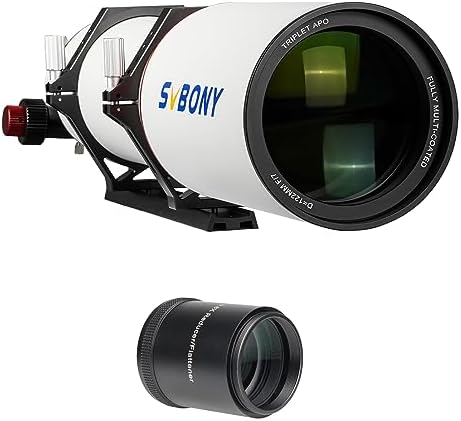
The SVBONY SV550 122mm Kit is a premium all-in-one solution for serious astrophotographers. With a 122mm aperture, it gathers more light for fainter deep sky objects and offers clearer, detailed images.
We may earn a commission when you buy through this link, at no additional cost to you.
This bundle includes a mini guide scope and a telescope camera, which simplifies the initial setup for tracking. The 1.23-megapixel camera has a high QE sensor perfect for tight tracking of faint guide stars.
The telescope features a FPL-51 triplet lens structure that greatly reduces chromatic aberration. While heavier, the portable handle makes it manageable to carry for travel setups.
Ideal for enthusiasts wanting a complete package, this kit delivers exceptional performance. The included accessories make it easy to start imaging quickly without buying separate components.
The larger 122mm aperture allows you to capture fainter deep sky objects with greater detail and clarity than smaller scopes.
The bundled guide scope and camera streamline the autoguiding process, ensuring precise tracking for long-exposure imaging.
We may earn a commission when you buy through this link, at no additional cost to you.
The Explore Scientific ED80 is a classic choice for those seeking reliable performance with USA-based support. Its FCD1 HOYA ED glass ensures excellent views with stunning details and high contrast.
We may earn a commission when you buy through this link, at no additional cost to you.
The air-spaced triplet optical design virtually eliminates chromatic aberration, perfect for capturing images of the Moon and planets. The push-pull adjustments on the front cell emphasize precision collimation.
Weighing more than some competitors, it features a retractable dew shield for portability. The USA support provides peace of mind for customers dealing with issues or questions.
This scope is a solid investment for dedicated astronomers who value optical quality and service. It remains a top contender for those willing to pay for premium materials and support.
The use of genuine FCD1 HOYA extra-low dispersion glass ensures minimal color fringing and maximum clarity in your images.
Push-pull adjustments allow users to fine-tune collimation easily, resulting in the tightest stars possible during imaging.
We may earn a commission when you buy through this link, at no additional cost to you.
This bundle offers a comprehensive imaging solution by including the SV209 field flattener. It ensures flat fields across the sensor, which is crucial for high-quality deep sky astrophotography.
We may earn a commission when you buy through this link, at no additional cost to you.
The 1.0X flattener corrects the field curvature effectively, supporting both half-frame and full-frame cameras. The 180mm dovetail plate provides a stable mount for diverse accessories.
Extinction measures inside the barrel reduce stray light, enhancing contrast. The magnesium alloy focusing seat reduces load, making it easier to carry during field sessions.
Perfect for photographers who want a ready-to-go setup, this bundle saves money and time. It delivers sharp, wide-field images suitable for capturing large nebulae and star clusters.
The included field flattener corrects curvature, ensuring stars remain sharp and round even at the edges of your sensor.
Designed to support full-frame cameras, this kit ensures you get the most out of your existing imaging equipment.
We may earn a commission when you buy through this link, at no additional cost to you.
The SV550 APO with the SV211 dovetail base focuses on portability and ease of use. The comfortable and convenient carrying handle makes transporting the large-aperture telescope straightforward.
We may earn a commission when you buy through this link, at no additional cost to you.
With a 122mm aperture, it gathers more light for clear, detailed images suitable for fainter deep sky objects. The included mounting bracket simplifies installing a guide scope or finder.
Despite the large aperture, the design remains easy to carry out when fitted into a carrying case. The 854mm focal length offers a good balance for various targets.
Ideal for observers who value mobility, this bundle is a practical choice. It provides the light-gathering power needed for serious work without compromising on transportability.
The portable handle design ensures that you can carry the large telescope comfortably, even over longer distances.
A 122mm aperture provides significant light gathering, allowing you to see fainter details in nebulae and galaxies.
We may earn a commission when you buy through this link, at no additional cost to you.
The SVBONY SV503 features a 102mm aperture and FMC coating to deliver brighter, higher-contrast images. The S-FPL51 ED glass minimizes color fringing for true-to-life colors.
We may earn a commission when you buy through this link, at no additional cost to you.
A 360° field rotator and dual-speed focuser make achieving critical focus effortless for astrophotography. The 90mm focus travel allows precise focusing with accessories like filter wheels.
The aluminum retractable hood blocks stray light and prevents dew formation. This makes it perfect for adult astronomers who observe the night sky frequently.
Suitable for both visual and imaging use, this scope offers great versatility. Its large diameter provides a significant upgrade in detail compared to smaller telescopes.
The dual-speed focuser with 1:10 reduction allows for precise focus adjustments needed for sharp planetary images.
With 102mm of aperture, this telescope collects more light than standard 80mm models for better visibility of faint objects.
We may earn a commission when you buy through this link, at no additional cost to you.
This kit includes the SV209 0.8X focal reducer, specifically designed for prime focus astrophotography. It corrects field curvature and improves image quality at the edge of the field of view.
We may earn a commission when you buy through this link, at no additional cost to you.
The 122mm aperture gathers more light for clear images suitable for deep sky photography. The included SV211 dovetail base provides a comfortable and convenient carrying handle for transport.
Installation is easy with the provided M6 and M4 screws. The design is optimized for shooting astronomy enthusiasts who want a complete system.
This is a great choice for those who want to start imaging immediately without buying separate reducers. It balances performance and ease of use for experienced users.
The 0.8X focal reducer widens the field of view, allowing you to capture larger deep sky targets more effectively.
Improving edge quality ensures that stars remain round across the entire sensor, crucial for professional-looking astrophotos.
We may earn a commission when you buy through this link, at no additional cost to you.
The SV550 80 Kit focuses on delivering sharp images with its ultra wide band fully multilayer coated lens. It effectively improves the image quality problem of fringe field curvature with the SV209 flattener.
We may earn a commission when you buy through this link, at no additional cost to you.
Designed for revealing the wonders of celestial bodies, it is perfect for observing the Messier catalog targets like M42 and M45. The difficulty factor for use is simple and straightforward.
The 30mm achromatic optics prevent irritating reflections for bright and clear images. The convenient carrying handle improves the safety factor during installation and transport.
This kit is ideal for beginners seeking to explore deep sky objects without complex setups. Its balanced design ensures enjoyable viewing and imaging experiences for all skill levels.
Fully multilayer coated lenses ensure maximum light transmission and sharp, high-contrast views of celestial targets.
The SV209 flattener corrects field curvature, ensuring that images remain sharp across the entire camera sensor.
We may earn a commission when you buy through this link, at no additional cost to you.
The SV550 APO refractor features a 122mm aperture for clearer, detailed images suitable for fainter deep sky objects. Its high limiting magnitude allows you to see faint details in the night sky.
We may earn a commission when you buy through this link, at no additional cost to you.
Adopting a FPL-51 triplet apochromatic lens structure, it provides better correction of aberration. This greatly reduces chromatic aberration and enhances the clarity and sharpness of your view.
The portable handle and dovetail base allow for easy carrying and moving. Installation is made simple with the provided mounting screws for finder scope brackets.
Perfect for serious observers looking for a reliable travel telescope, this model balances portability with performance. It is a practical choice for those who value image quality on the go.
The larger aperture and high limiting magnitude enable detection of fainter nebulae and galaxies that smaller scopes miss.
The FPL-51 triplet design ensures maximum sharpness and color correction for the most demanding observing sessions.
We may earn a commission when you buy through this link, at no additional cost to you.
Selecting the right apochromatic refractor requires understanding key factors that impact image quality and usability. This guide breaks down the essential elements to consider before buying.
Aperture determines how much light the telescope can gather. Larger apertures like 122mm reveal fainter deep sky objects, while smaller ones like 80mm offer better portability for travel.
APO refractors use ED glass to minimize chromatic aberration. Look for models with S-FPL51 or FCD1 HOYA glass for the best color correction and contrast in your images.
Focal ratio affects imaging speed. A faster ratio like f/6 is better for deep sky photography, while f/7 is versatile for both planetary and deep sky visual observing.
Consider the weight and size. Lighter scopes like the 71F are easier to transport, while larger models offer better performance but require sturdy mounts and vehicles.
Ensure the dovetail plate matches your mount. Vixen or Losmandy styles are common. A stable mount is crucial to prevent vibration during long exposures.
Check if field flatteners or reducers are included. Bundles that include camera adapters save money and ensure compatibility with your existing imaging gear.
APO refractors range in price. Set a budget that allows for a quality OTA and necessary accessories. Remember that higher prices often mean better glass and support.
Start by ensuring your mount is stable and polar aligned to prevent tracking errors. Use the provided finder scope to locate your target before switching to the eyepiece or camera.
An apochromatic refractor uses special low-dispersion glass and multi-element lenses to eliminate color fringing. This provides sharp, true-to-life images of celestial objects.
Yes, they are excellent for astrophotography due to their color correction and sharpness. They minimize chromatic aberration, ensuring clean images across the frame.
Most APOs require a field flattener for imaging to prevent curved stars at the edges. Some kits include this accessory for better image quality.
Store it in a dry place and use dew shields. Clean lenses only with professional lens tissue when necessary to avoid damaging coatings.
Use a sturdy equatorial mount that can handle the weight of the OTA and accessories. Vibration-free tracking is essential for sharp deep sky images.
Yes, but never point it at the sun. It can be used for terrestrial viewing of landscape or birds during the day safely.
Our top picks highlight the SVBONY SV550, Askar 71F, and SVBONY 122mm Kit for their balance of performance and value. Each offers unique strengths for specific observing needs.