
KK 2.1.5 Flight Control Board
5.0Editor score
Self-balancing aerobatics
VTOL and Vtail support
Advanced flight control
This guide compares the top flight controllers for hybrid Vtol and Vtol drones to help you choose the best autopilot system for your unique aerial build.
Finding the right flight controller for hybrid Vtol and Vtol drones is crucial for stable transitions and reliable autonomous operations. These systems must manage complex aerodynamics across multiple flight modes without compromising performance or safety.
We evaluated ten leading flight controllers based on processor power, firmware support, sensor redundancy, and compatibility with fixed-wing and multirotor configurations. Our analysis focuses on real-world applicability for hobbyists and professionals alike.
Each pick highlights specific strengths like budget value, premium features, or open-source flexibility. Prices and availability fluctuate often, so verify current listings before purchasing to ensure you get the latest hardware revisions.
5.0Editor score

4.8Editor score
The following table provides a side-by-side comparison of all ten flight controllers evaluated in this guide, highlighting key specifications and compatibility for hybrid Vtol builds.



The KK 2.1.5 Flight Control Board stands out as a top choice for those seeking affordable stability and control. With a perfect 5.0 rating, it offers excellent flight control capabilities and self-balancing aerobatics ideal for FPV racing drones.
We may earn a commission when you buy through this link, at no additional cost to you.
This controller ensures stability and flexibility in different flight occasions, specifically tailored for vertical takeoffs and landing VTOL and Vtail aircraft. It allows both experienced and technology savvy individuals to explore flight control systems and perform challenging maneuvers.
While it lacks some advanced features found in higher-end models, its focus on fundamental stability makes it acceptable for many hobbyist projects. The self-leveling and acrobatic flight support add excitement to flying experiences without breaking the budget.
Beginners and intermediate hobbyists should consider this controller for its user-friendly approach and customizable features. It is a reliable starting point for aerial photography projects and model aircraft competitions.
Designed specifically for VTOL and Vtail aircraft, ensuring stability during transition phases.
Allows users to customize flight parameters and perform challenging maneuvers with ease.
We may earn a commission when you buy through this link, at no additional cost to you.
The COREWING F405 V2 Flight Controller is built specifically to fit RC airplanes and drones. It leverages the robust F405 processor to deliver reliable performance for fixed-wing and hybrid configurations.
We may earn a commission when you buy through this link, at no additional cost to you.
This unit provides a straightforward integration option for users looking to upgrade existing RC setups. Its design focuses on core flight stability without unnecessary complexity.
Users may find documentation and feature descriptions limited compared to open-source alternatives. However, for standard RC applications, it offers sufficient control.
Hobbyists needing a dedicated solution for airplane builds should evaluate this option for its specific hardware alignment.
Tailored specifically for RC airplane and drone applications with optimized performance.
We may earn a commission when you buy through this link, at no additional cost to you.
The PIX 2-12S Mavlink SBUS PPM CRSF Flight Controller offers high voltage support up to 12S for demanding builds. It integrates a STM32F405VGT6 main controller with advanced sensors for precise flight control.
We may earn a commission when you buy through this link, at no additional cost to you.
This controller supports multiple receiver protocols and is suitable for autonomous driving systems in roaming vehicles. Its board size and weight are optimized for compact multirotor VTOL designs.
Installation requires careful wiring and understanding of power constraints. Users may need to source additional GPS and ESC components separately.
Advanced DIY enthusiasts seeking maximum voltage flexibility should consider this board for complex hybrid applications.
Supports 2 to 12S power supply for high-performance motor configurations.
We may earn a commission when you buy through this link, at no additional cost to you.
The Pixhawk 2.4.8 PX4 is a leading open source flight controller combo with GPS. It serves as a master controller for fixed-wing multirotor and helicopter systems with high-end configuration.
We may earn a commission when you buy through this link, at no additional cost to you.
Its ARM Cortex M4 core and fail-safe co-processor enable robust autonomous operations. Hobbyists can carry out secondary development on this efficient flight controller.
A quick start guide helps new players with basic assembly and calibration. The 3-month repair or replacement policy covers quality problems.
Researchers and developers looking for customizable autopilot solutions should prioritize this model for its stability and open-source ecosystem.
Enables rich function modules and secondary development for advanced users.
We may earn a commission when you buy through this link, at no additional cost to you.
The F405 Wing Flight Controller supports VTOL capabilities and Ardupilot firmware for advanced performance. Users can configure flight parameters via smartphone with convenient APP control.
We may earn a commission when you buy through this link, at no additional cost to you.
It is designed for fixed-wing drones, offering flexible flight modes and fast processing. Its lightweight design minimizes added weight while maintaining functionality.
While the price is higher, the ease of configuration for beginners and experienced pilots is a trade-off worth considering.
Pilots prioritizing mobile setup and app integration should select this controller for versatile builds.
Easily configure and monitor flight parameters via smartphone app.
We may earn a commission when you buy through this link, at no additional cost to you.
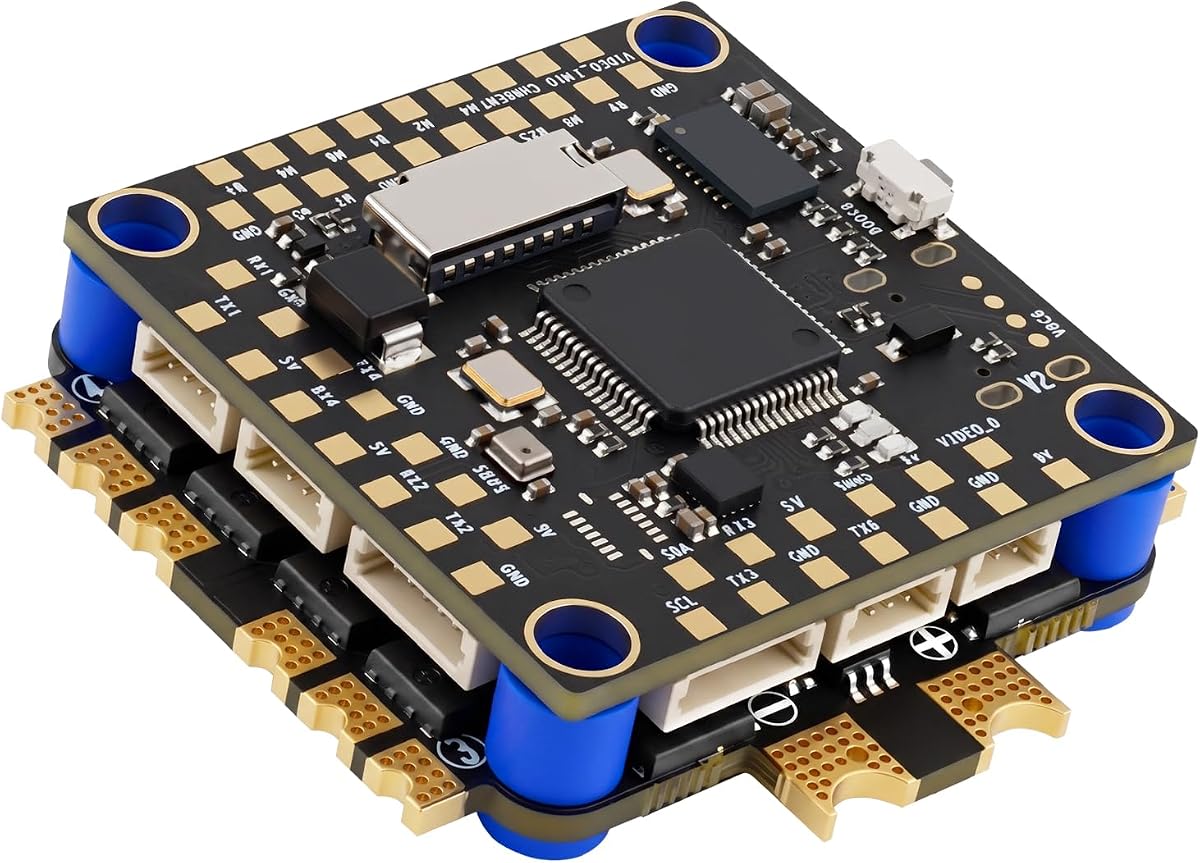
The H743 Flight Controller with 60A 32 bit ESC offers a high-performance combo. It features dual IMUs and supports 2-8S LiPo batteries for powerful builds.
We may earn a commission when you buy through this link, at no additional cost to you.
Firmware support includes Betaflight, INAV, PX4, and Ardupilot, ensuring versatility across FPV and racing drones. It provides seven UART ports for extensive connectivity.
The stack weighs only 23.2g, fitting standard 30×30 frames. Power delivery is optimized with over 80A burst current.
Enthusiasts seeking robust power handling and firmware flexibility should choose this stack.
Delivers 60A continuous current with burst capacity over 80A.
We may earn a commission when you buy through this link, at no additional cost to you.
The H743 Flight Controller with 50A 8 bit ESC provides a reliable standard power solution. It supports 2-6S LiPo batteries and includes dual IMUs for sensor redundancy.
We may earn a commission when you buy through this link, at no additional cost to you.
This stack offers high-frequency PWM and DSHOT protocols for precise throttle response. It weighs 21.5g, making it easy to integrate into various frames.
Users may find 8-bit ESC limits less suitable for high-endurance builds compared to 32-bit options.
Beginners and standard racing pilots seeking simplicity should consider this compact stack.
Compact stack design simplifies installation and enhances assembly efficiency.
We may earn a commission when you buy through this link, at no additional cost to you.
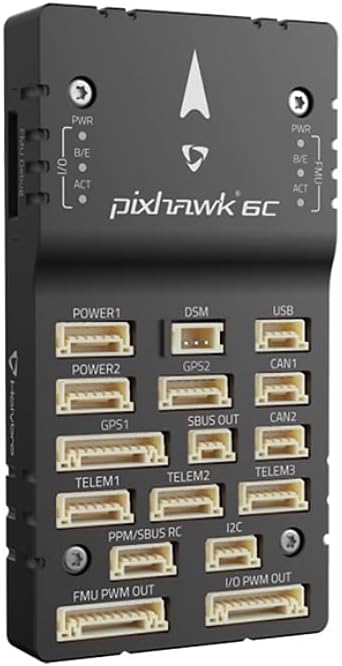
The Pixhawk 6C Flight Controller delivers premium performance with a powerful STM32H743 480MHz processor. It features dual redundant IMUs and temperature control for unmatched reliability.
We may earn a commission when you buy through this link, at no additional cost to you.
Pre-installed PX4 Autopilot supports academic research and commercial applications. An integrated vibration isolation system filters out high-frequency drone vibration.
The plastic case version is ultra-light at 34.6g. Users may need to open the casing to switch PWM signal modes.
Professors and commercial users requiring advanced sensor reliability should prioritize this top-tier controller.
Features integrated vibration isolation and temperature control for consistent sensor readings.
We may earn a commission when you buy through this link, at no additional cost to you.
The AERO SELFIE F405NC Flight Controller offers compatibility with O3 and O4 AIR interfaces. It includes a DPS310 barometer for accurate altitude sensing.
We may earn a commission when you buy through this link, at no additional cost to you.
Supporting 2-6S LiPo and dual IMUs, this stack provides quick configuration options for FPV & racing drones. It fits standard 30×30 mounting patterns.
While the 8-bit ESC may limit advanced users, the integration features are beneficial for modern setups.
Racers needing specific video interface support should evaluate this stack for compatibility.
Compatible with O3 O4 AIR interface for latest video transmission systems.
We may earn a commission when you buy through this link, at no additional cost to you.
The AERO SELFIE H743 Flight Controller combines 60A 32 bit ESC performance with broad firmware support. It includes seven UART ports and CAN for extensive expansion.
We may earn a commission when you buy through this link, at no additional cost to you.
Supporting 2-6S LiPo and dual IMUs, it delivers responsive throttle control. The stack weighs 23.2g and offers compact design.
User ratings suggest some setup challenges or variability. However, features align well with hybrid Vtol needs.
Users seeking 32-bit ESC power at a competitive price should consider this option despite mixed reviews.
Offers seven UART ports and CAN bus for extensive peripheral connectivity.
We may earn a commission when you buy through this link, at no additional cost to you.
Selecting the right flight controller requires careful consideration of several critical factors to ensure optimal performance.
Firmware determines the capabilities of your flight controller. Open-source options like PX4 and ArduPilot offer extensive features for autonomous VTOL transitions and waypoint navigation. Verify compatibility with your planned flight modes and sensor integration requirements.
Choose firmware that aligns with your project goals and technical comfort level.
High-performance processors handle complex algorithms needed for hybrid flight transitions. Look for modern ARM Cortex cores that support multiple sensor inputs and high update rates. Efficient processing ensures smooth responses to control inputs.
Prioritize controllers with robust processors for demanding VTOL configurations.
Dual IMUs and redundant compasses provide reliability during critical flight phases. Temperature-controlled sensors maintain accuracy across varying environmental conditions. Quality barometers ensure precise altitude hold.
Invest in controllers with redundant and temperature-regulated sensors for safety.
Flight controllers must support your battery configuration. Some models handle higher voltage inputs up to 12S. Check ESC compatibility and power distribution design.
Ensure power specs match your build requirements.
Sufficient UART ports and PWM outputs allow for GPS and telemetry connections. GH1.25 connectors facilitate easy receiver integration. Evaluate the wiring harness included.
Choose controllers with adequate connectivity for your peripherals.
Compact boards simplify integration into lightweight hybrid frames. Standard mounting patterns like 30x30mm offer flexibility. Consider vibration isolation features for sensor accuracy.
Select form factors suitable for your drone design.
Active communities help resolve setup challenges quickly. Comprehensive manuals and configuration guides are essential for beginners. Check for support resources before purchasing.
Opt for controllers with strong community backing.
Prices vary widely from budget-friendly boards to premium systems. Define your needs and balance cost with required features. Higher cost often means better support and redundancy.
Allocate budget according to critical performance needs.
Begin by configuring the firmware according to your specific airframe and motor layout. Use ground station software to calibrate accelerometers and gyroscopes for accurate sensor data.
Regularly update firmware to benefit from bug fixes and new features. Inspect connections for wear and tear to prevent signal loss during flight operations.
Store your drone in a dry environment and avoid exposing the controller to extreme temperatures. Vibration isolation pads help maintain long-term sensor accuracy.
A hybrid VTOL flight controller must support both multirotor and fixed-wing flight modes seamlessly. It should include robust firmware like PX4 or ArduPilot to manage complex transitions smoothly. Proper sensor redundancy ensures safe operation during critical flight phases.
Open-source controllers often offer more flexibility and customization options for hybrid builds. They typically support advanced automation features necessary for VTOL transitions. However, they may require more technical expertise to configure correctly.
Some flight controllers are sold as combo packages including GPS modules for convenience. Others require separate purchase and connection. Always check the product description to see if GPS is included or an additional accessory.
Dual IMUs provide redundancy so the flight controller can cross-check sensor data. This reduces errors caused by vibration or sensor malfunction. It is especially important for autonomous VTOL missions requiring high reliability.
Most controllers support standard 1Wire or UART ESC protocols like DSHOT or ONESHOT. Ensure your ESC firmware is compatible with the chosen flight controller settings. Some stacks include ESCs designed for optimal pairing.
Sensor calibration is typically done through ground station software like Mission Planner. Place the drone on a level surface and follow the calibration prompts for accelerometer and compass. Proper calibration ensures stable flight.
Most controllers support 2 to 8S LiPo batteries for standard builds. Some advanced models handle up to 12S for high-power systems. Verify the voltage range on the product specifications before connecting batteries.
Vibration isolation filters high-frequency noise from motors and props affecting sensors. Integrated or add-on isolation improves altitude and attitude accuracy. This is vital for smooth transitions in VTOL flight.
The top picks offer a range of solutions from affordable budget boards to premium open-source systems. Each option balances performance with specific use cases for hybrid Vtol and Vtol drones.
Prioritize firmware compatibility and sensor redundancy when planning your build. These factors are critical for safe and successful autonomous transitions.
Always verify the current prices and availability before making your final decision to ensure you get the latest hardware specifications.