
SOLPERK Solar Panel Kit 20W 12V Solar Battery Charger Maintainer+Controller
4.5Editor score
High Conversion Rate Cells
Smart Charge Controller
Easy Angle Adjustable Mount
This guide compares the top 10 marine solar panels for 2026, evaluating efficiency, durability, and charging performance to help you choose the right power
Marine solar panels are essential for keeping your vessel powered while on the water. Whether you are sailing, cruising, or living aboard, having a reliable energy source ensures your electronics stay charged and your batteries remain healthy without constant engine running.
We compared ten top-rated solar solutions based on cell efficiency, weather resistance, mounting flexibility, and charge controller integration. Each product was evaluated for its suitability in marine environments, focusing on corrosion resistance and power output consistency under varying light conditions.
Each pick highlights key features like bifacial technology, anti-shading design, and flexible mounting options. Prices and availability can change quickly, so verify current details before purchasing to ensure you get the best value for your specific marine power needs.
4.5Editor score

4.4Editor score
4.6Editor score
This side-by-side comparison highlights the key specifications and strengths of each marine solar panel option. Use this table to quickly identify which model fits your boat size, battery type, and power requirements.


The SUNER POWER Waterproof 20W kit stands out for its advanced MPPT technology and versatile charging modes. It holds a strong rating for reliability in marine and automotive use, making it a top choice for maintaining battery health.
We may earn a commission when you buy through this link, at no additional cost to you.
Its Ultra-Smart MPPT technology delivers up to 99% tracking efficiency, significantly outperforming standard PWM controllers. The three-stage charging algorithm ensures batteries are safely recharged and optimized, whether they are AGM, Gel, or Lithium types.
While the 20W output is modest for large systems, it is ideal for trickle charging smaller boat batteries. The visual charging level indicators allow you to monitor progress at a glance, though the included suction cups may require replacement for permanent mounting.
This kit is best suited for sailors or boat owners who need a reliable, low-maintenance way to keep batteries topped off between trips. Its robust safety features and smart charging make it a dependable pick for marine environments.
The Ultra-Smart MPPT controller maximizes energy harvest even in low-light conditions, ensuring you get the most power from every sun hour on the water.
Switch easily between 12V, 12V AGM, and 12V Lithium modes to match your specific battery technology without risking overcharging or damage.
We may earn a commission when you buy through this link, at no additional cost to you.
The SOLPERK 20W kit offers an affordable entry point for marine solar maintenance without sacrificing durability. It includes everything needed for quick installation, making it popular for small boats and maintenance projects.
We may earn a commission when you buy through this link, at no additional cost to you.
Featuring monocrystalline A+ cells with 21-30% efficiency, this panel captures sunlight effectively even in partial light. The 8A smart controller prevents overcharging while the adjustable bracket lets you optimize the angle for maximum sun exposure on deck.
The main trade-off is the lack of MPPT technology, which limits efficiency compared to premium models. However, for basic maintenance needs, the plug-and-play setup and robust weatherproof construction provide excellent value and ease of use.
Ideal for budget-conscious owners needing a simple, effective solution to prevent battery drain on small vessels. The adjustable mount and included accessories make it a practical choice for temporary or seasonal marine applications.
The 360-degree adjustable bracket ensures you can position the panel at the perfect angle to capture sunlight throughout the day on a moving boat.
Built with low-iron tempered glass and a corrosion-resistant frame, this panel withstands salt spray, rain, and wind for long-term reliable performance.
We may earn a commission when you buy through this link, at no additional cost to you.
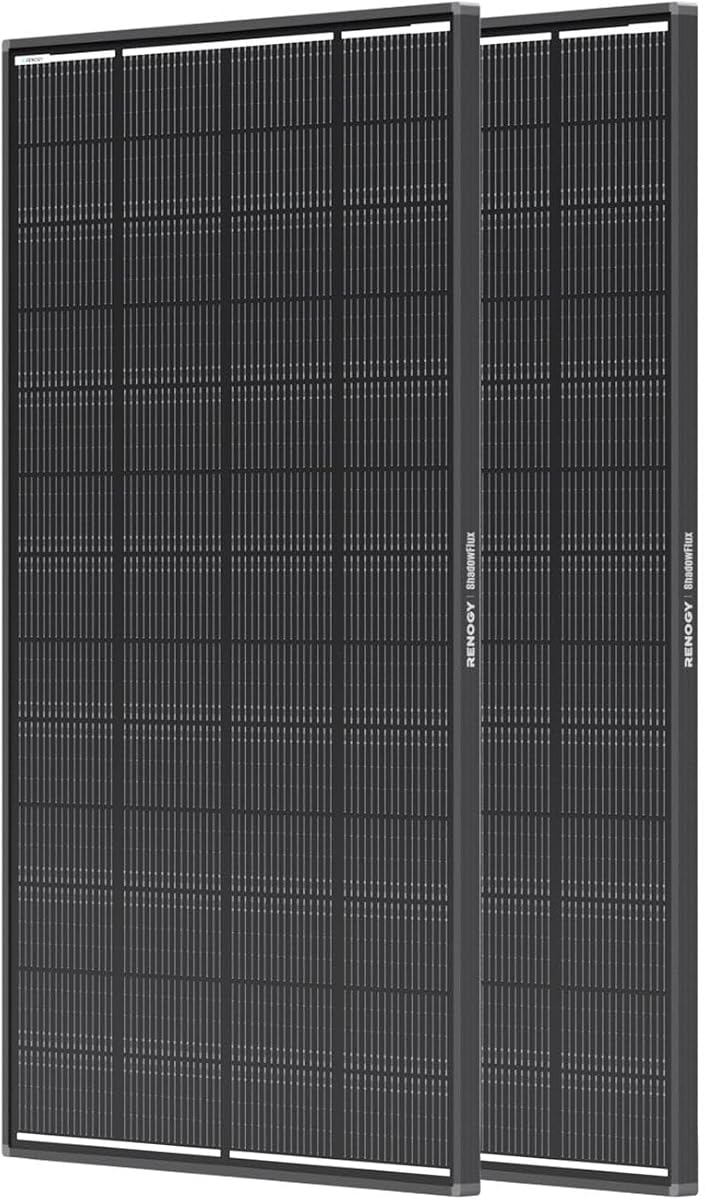
The Renogy 400W ShadowFlux panel delivers exceptional power for serious marine applications where space is limited. Its advanced N-Type cells and anti-shading tech make it a standout for high-performance energy needs.
We may earn a commission when you buy through this link, at no additional cost to you.
ShadowFlux technology ensures reliable power even if part of the panel is shaded by rigging or sails. The 25% high-efficiency cells maximize energy conversion, while the compact design fits more panel into less roof space compared to traditional PERC models.
While the output is substantial, the size and price are investment considerations for smaller boats. However, for large cruisers or liveaboards, the reliability and efficiency justify the cost, especially with its IP67 rating for harsh conditions.
This panel is perfect for owners seeking maximum power output and advanced protection against environmental stress. The balance of high efficiency and compact design makes it a top-tier choice for modern marine solar systems.
Even when partially shaded by masts or sails, ShadowFlux technology ensures consistent power generation so you never lose energy on the water.
Advanced N-Type cells deliver 25% efficiency, maximizing energy production per square foot to meet high-power demands efficiently.
We may earn a commission when you buy through this link, at no additional cost to you.
The Callsun 400W bifacial panel uniquely captures light from both front and rear sides, boosting energy output when mounted over reflective surfaces. Its high efficiency and dual-module design make it ideal for diverse marine setups.
We may earn a commission when you buy through this link, at no additional cost to you.
N-type monocrystalline cells provide 25.6% conversion efficiency, while the transparent backsheet allows reflected light to generate extra power. The TwinCell anti-shading design ensures one section keeps producing even if the other is shaded by boat equipment.
The main consideration is installing it where light can reflect off the surface, such as a white deck. If space is limited, the 51-inch length requires planning, but the dual-module protection ensures consistent power generation in variable conditions.
Perfect for boat owners with available roof space who want maximum energy harvest. The high efficiency and unique bifacial design offer a competitive edge for off-grid and marine power systems seeking reliability.
The transparent backsheet captures light from below, increasing total energy output and improving efficiency when installed on reflective surfaces.
Dividing the panel into two sections means partial shade affects only half, maintaining consistent power for critical marine electronics.
We may earn a commission when you buy through this link, at no additional cost to you.
The Renogy 200W ShadowFlux panel balances power and size well for marine use. Its compact footprint and high efficiency make it suitable for boats with limited space but significant power needs.
We may earn a commission when you buy through this link, at no additional cost to you.
N-Type cells with 25% efficiency ensure strong energy conversion, while the anti-shading tech minimizes losses from rigging or sails. The design is 7% smaller than standard panels, allowing more flexible placement on curved or irregular surfaces.
Though it offers strong performance, the output is moderate compared to larger arrays. Installation requires secure mounting to handle wind, but the IP67 rating ensures durability against rain and salt spray for long-term marine use.
This panel is best for cruisers needing reliable mid-range power. Its balance of efficiency, compactness, and durability makes it a practical and modern choice for diverse vessel setups.
Being 7% smaller than traditional panels allows fitting more power into limited deck or roof space on smaller vessels.
N-Type technology delivers 25% efficiency, ensuring maximum power output per square foot for your marine energy system.
We may earn a commission when you buy through this link, at no additional cost to you.
The Renogy 200W flexible panel adapts to curved surfaces where rigid panels won't fit. Its ultra-flex design and lightweight construction make it perfect for boats with complex deck layouts.
We may earn a commission when you buy through this link, at no additional cost to you.
It weighs half as much as rigid panels and bends up to 240 degrees, allowing seamless integration on curved roofs or hatches. The half-cut PERC cell technology improves light capture, and the all-black design offers a sleek, glare-free look.
Installation requires a smooth surface for maximum contact, and the flexible material may be less durable than rigid glass over many years. However, its adaptability and pre-drilled holes simplify setup for non-standard mounting locations.
Ideal for boat owners with curved surfaces or limited flat space. The flexibility and lightweight design offer a unique solution for maximizing solar coverage on unconventional marine structures.
The 240-degree bendable design allows mounting on curved roofs or irregular surfaces, expanding placement options beyond flat decks.
At half the weight of rigid panels, it reduces top-heavy strain while maintaining IP67 waterproof protection for marine environments.
We may earn a commission when you buy through this link, at no additional cost to you.
The Renogy 120W ShadowFlux panel offers a balanced mix of efficiency and size for moderate marine power needs. Its advanced cell tech and protective features ensure reliable performance in harsh marine environments.
We may earn a commission when you buy through this link, at no additional cost to you.
Featuring 25% efficiency N-Type cells, it generates strong power even when partially shaded by sails or rigging. The panel is 10% more compact than standard options, saving space while maintaining high energy output per unit.
While 120W is moderate for large systems, it is well-suited for maintaining house batteries on smaller vessels. The IP67 rating protects against water and dust, ensuring long-term durability despite exposure to salt and wind.
Best for cruisers who need a reliable mid-power source without overwhelming space constraints. Its combination of compact size and high efficiency makes it a practical choice for diverse boat configurations.
Being 10% smaller than traditional panels helps maximize use of limited deck area on compact vessels.
The IP67 rating and advanced encapsulation ensure the panel withstands salt spray, rain, and wind for years.
We may earn a commission when you buy through this link, at no additional cost to you.
The Renogy 100W N-Type panel delivers strong performance in a compact package suitable for small boats or auxiliary power. Its high efficiency and durable build ensure consistent energy generation in marine conditions.
We may earn a commission when you buy through this link, at no additional cost to you.
With 25% conversion efficiency and advanced 16BB technology, it produces more power than conventional panels of the same size. The low temperature coefficient minimizes power loss in hot weather, which is crucial for summer boating.
The 100W output is ideal for maintaining batteries rather than running high-draw appliances. Its IP67 protection and tempered glass ensure resistance to salt spray and wind, while the aluminum frame adds structural integrity.
Perfect for weekend cruisers needing reliable maintenance charging. Its efficiency and compact size make it a practical addition to any small vessel or auxiliary energy system.
The low temperature coefficient ensures stable power output even on hot summer days when panels typically lose efficiency.
25% efficiency cells produce more power per square foot, optimizing limited deck space for maximum energy harvest.
We may earn a commission when you buy through this link, at no additional cost to you.
The SUNER POWER 50W kit offers solid power for maintenance with smart MPPT charging. It provides a versatile solution for keeping batteries healthy during storage or short voyages.
We may earn a commission when you buy through this link, at no additional cost to you.
Its Ultra-Smart MPPT controller ensures up to 99% tracking efficiency, optimizing energy harvest even in low light. The three-stage charging algorithm protects batteries while the visual indicators let you monitor progress at a glance.
The 50W output is sufficient for moderate battery maintenance but may not support heavy loads. While the suction cups are convenient for temporary installs, permanent mounting requires more secure hardware for marine conditions.
Ideal for boat owners seeking a reliable, low-maintenance charging solution. Its smart features and robust protections make it a practical choice for maintaining battery health efficiently.
The 99% tracking efficiency ensures maximum energy is captured and stored, even under less than ideal sun conditions.
LED indicators show charging progress from 25% to 100%, allowing easy monitoring of battery health.
We may earn a commission when you buy through this link, at no additional cost to you.
The POWOXI 7.5W charger is a simple, portable option for preventing battery drain during long storage periods. It is best for small vessels or maintaining starter batteries between trips.
We may earn a commission when you buy through this link, at no additional cost to you.
Its smart protection system prevents overcharging and short circuits, ensuring safety for all battery types. The scratch-resistant ABS+PC frame is durable and lightweight, while the LED indicator clearly shows sunlight reception and charging status.
The 7.5W output is minimal, so it works best as a maintenance aid rather than a primary power source. It is easy to place on a deck or dashboard for passive charging without complex installation.
Suitable for small boats or temporary storage. Its simplicity and safety features make it an affordable choice for preventing dead batteries on smaller craft.
Built-in protection prevents overcharging and short circuits, keeping your battery safe during extended use.
The lightweight build allows easy placement on any flat surface for quick maintenance charging.
We may earn a commission when you buy through this link, at no additional cost to you.
Selecting the right solar panel involves matching wattage, technology, and mounting options to your vessel and power needs.
Determine your daily energy consumption to choose the right panel size. Small boats may need 20-50W for maintenance, while larger vessels might require 200-400W or more to run electronics and appliances.
Match the panel wattage to your battery bank size and typical usage patterns to ensure consistent charging without overcomplicating your system.
Look for N-type or PERC cells with high efficiency ratings around 25% or higher. Advanced technology like bifacial designs or anti-shading features can significantly improve power generation in real-world conditions.
Higher efficiency means more power per square foot, which is crucial for limited deck space on boats.
Marine panels must withstand salt spray, UV exposure, and high winds. Ensure the panel has an IP67 or IP68 rated junction box and a corrosion-resistant aluminum frame to prevent degradation over time.
Check ratings for wind and snow loads to guarantee the panel survives harsh sea conditions without damage.
Choose rigid panels for durability and efficiency on flat roofs. Flexible panels are ideal for curved surfaces but may have a higher cost and slightly lower lifespan.
Consider your deck layout: use flexible panels for curved areas and rigid for flat, durable mounting spots.
Always pair panels with an MPPT controller for maximum efficiency. PWM controllers are cheaper but waste energy. Look for kits that include compatible controllers or plan to buy separately.
Ensure the controller supports your battery type, such as AGM, Gel, or Lithium, to avoid damage.
Consider mounting options like adjustable brackets or permanent rails. Temporary installations may use suction cups, but permanent mounts are better for marine safety and wind resistance.
Ensure your deck can support the weight and wind load of the panel system before purchase.
Choose brands offering long-term warranties such as 25 years for performance. Strong after-sales support helps if you encounter issues or need replacement parts.
Look for products with clear warranty terms and reputable customer service to protect your investment.
Higher wattage panels cost more but offer better long-term value for larger boats. Balance your upfront budget with expected energy needs to find the most cost-effective solution.
Evaluate the total cost of ownership including controllers and mounting gear before deciding on a specific model.
Regularly clean the panel surface with fresh water and mild soap to remove salt and debris. Dirt and salt buildup can reduce efficiency by blocking sunlight from reaching the cells.
Inspect cables and junction boxes for wear or corrosion every few months. Ensure all connections are tight and protected from water exposure to maintain safe and consistent performance.
Position panels to face the sun for maximum exposure, especially on stationary boats. Adjust tilt or angle seasonally if possible to optimize energy harvest throughout the year.
No, most solar panels output DC power compatible with charge controllers and batteries. You only need an inverter if you want to convert DC to AC for standard household appliances on your boat.
Yes, marine solar panels are designed to withstand movement and wind. Secure mounting brackets and durable construction ensure they perform reliably even while underway in rough water.
It depends on your energy use. Small boats may need one 20W panel for maintenance, while larger vessels often require 200W or more to power electronics and appliances regularly.
Yes, quality marine panels have IP67 or IP68 ratings to protect against water and dust. They are built to handle salt spray, rain, and wind without degradation.
Most panels last 25 years. Replace if output drops significantly or physical damage occurs like cracks or corrosion that affects performance and safety.
It is not necessary as modern controllers prevent backflow. However, disconnecting during long storage helps reduce wear and ensures safety during maintenance.
Choosing the right solar panel involves balancing power needs with space constraints. Our top picks highlight versatile options like the SUNER POWER 20W kit for maintenance and the Renogy 400W ShadowFlux for high-performance systems.
Prioritize durability, efficiency, and mounting flexibility to ensure reliable power on the water. Consider your battery type and whether you need flexible or rigid panels to fit your deck layout.
Always verify current prices and availability before purchase since these factors change frequently. Selecting a model with strong warranty support ensures long-term reliability for your marine adventures.